Industry update : NABH GUIDEBOOK FOR CLIMATE ACTION AND SUSTAINABILITY IN HEALTHCARE

National Accreditation Board for Hospitals and Healthcare Providers (NABH) has been developing quality healthcare standards . NABH standards have always focused on creating an ecosystem for quality and safety of the services delivered in the healthcare organizations.

As a step towards addressing the biggest challenge of 21st century i.e. climate change and sustainability, NABH has developed a simple checklist to guide NABH accredited and certified healthcare organizations to achieve climate change adaption, resilience and sustainability.

This cohesive document includes essential of concept of sustainability in healthcare, guidance for implementation and strategic framework. To motivate healthcare organizations, industry best practices are also showcased in the document.

This document along with a self-assessment checklist is available for free download in NABH website http://www.nabh.co/

Source: http://www.nabh.co/

Industry update : NABL 112A & NABL 112B

National Accreditation Board for Testing and Calibration Laboratories (NABL) is an accreditation body that provides accreditation service to Conformity Assessment Bodies including medical testing laboratories. On December 18,2024, the following documents were issued by NABL.

1 – NABL 112ASpecific Criteria for Accreditation of Medical Laboratories

NABL 112 is a Specific Criteria for Accreditation of Medical Laboratories, prepared by a Technical Committee, which is aligned as per ISO 15189

NABL documents are updated at regular intervals to keep pace with the latest technical developments and to synchronize with the International Standards.

NABL has released NABL 112A which elaborates the requirements of International Standard ISO 15189:2022 as applicable to Indian setting. The document has been designed to make it user friendly for both NABL assessors and laboratories

This document specifies the criteria for the medical testing laboratories for obtaining NABL accreditation. Medical testing laboratory shall fulfill the requirements of this document in addition to the requirements of the ISO 15189:2022 – “Medical laboratories –Requirements for quality and competence”. This specific criteria document shall be used in conjunction with ISO 15189:2022..

2 – NABL 112 B – Guidance document for Medical Laboratories

NABL has issued 112B Document on 18th December 2024. This document shall provide guidance to medical testing laboratories for the following aspects:

– Operation of sample collection centres / facilities
– Sample format for preparing the scope of accreditation
– Lot verification
– Algorithm for Automated Selection and Reporting of Results
– Sample format for competency assessment
– Examples for the type of sample and their stability for Clinical Biochemistry parameters

Click the buttons given below to read the documents in detail.

Source: https://nabl-india.org/


Industry Update – Establishment of the Global Accreditation Cooperation

The establishment of the Global Accreditation Cooperation (GLOBAC) marks a significant shift in the global accreditation landscape, merging the International Accreditation Forum (IAF) and the International Laboratory Accreditation Cooperation (ILAC) into a single entity.

This transition, aimed to be operational by January 2026, follows extensive discussions and agreements among IAF and ILAC members in 2024.

Key Developments

Formation of GLOBAC:

In 2019, IAF and ILAC members decided to create GLOBAC, which will take over their existing roles. The formal incorporation process began in New Zealand in October 2024 after the approval of GLOBAC’s Constitution and General Rules.

Mutual Recognition:

GLOBAC aims to enhance international trade by ensuring mutual recognition of accredited services across borders, thereby removing technical barriers. Until GLOBAC becomes operational, IAF and ILAC will continue their normal operations with existing recognition arrangements remaining valid

Transition Plan

Before Transition Date:

Until the Transition Date, IAF and ILAC will maintain their operations, and existing guidance for regulators will remain applicable. The IAF Multilateral Recognition Arrangement (IAF MLA) and ILAC Mutual Recognition Arrangement (ILAC MRA) will continue to function until GLOBAC takes over

After Transition Date:

Following the Transition Date, GLOBAC will assume all responsibilities of IAF and ILAC. Regulations referencing IAF MLA or ILAC MRA will gradually be updated to reflect GLOBAC’s framework. It is anticipated that the use of IAF MLA and ILAC MRA Marks will cease three years post-transition

Recommendations for Regulators:

Regulators are encouraged to collaborate with IAF and ILAC members to prepare for necessary changes in their documentation as GLOBAC becomes operational. This proactive approach will facilitate a smoother transition to the new accreditation framework

For further inquiries regarding this transition, stakeholders can contact the GLOBAC Executive Committee through its Secretary : secretary@globac.org

Industry Update – Addendum to NABL 112

ISO 15189:2022 is an international standard that specifies the requirements for quality and competence in medical lab environments. It is a standard that requires labs to develop a robust, reliable quality management system (QMS) to establish their competence.

This standard promotes the welfare of patients and satisfaction of laboratory users.

NABL 112 is a Specific Criteria for Accreditation of Medical Laboratories, prepared by a Technical Committee, which is aligned as per ISO 15189: Medical laboratories- Requirements for Quality & Competence

NABl has released the addendum document to NABL 112. Table specifying the applicability of this document to different clauses of ISO 15189:2022 are given below

ISO 15189: 2022 RequirementRefer NABL 112 Issue No. 4 Requirements
5.1 Legal entity
5.2 Laboratory Director
Page No. 10 – Organization and management responsibility
6.7 Service agreements   Agreement with laboratory users Agreement with POCT operatorsPage No. 11 – Service Agreements  
6.8.2 Referral laboratories and consultants
6.8.3 Review and approval of externally provided products and services      
Page No. 11 – 4 Examination by referral laboratories  
5.3.3 Advisory activitiesPage No. 12 – Advisory services
8.4 Control of records   Creation of records Amendment of records Retention of recordsPage No. 13 – Control of records  
8.8 EvaluationsPage No. 14 – Evaluation and audits
6.2 Personnel5.1 Personnel
6.3 Facilities and environmental conditions5.2 Accommodation and environmental conditions
6.4 Equipment
Equipment requirements
Equipment acceptance procedure
Equipment instructions for use
Equipment adverse incident reporting
Equipment records

6.5 Equipment calibration and Metrological traceability

6.5.2 Equipment Calibration  

6.6 Reagents and consumables
Receipt and storage
Acceptance testing
Inventory Management
Instructions for use
Adverse Incident Reporting
5.3 Laboratory equipment, reagents and consumables  
7.2 Pre-examination processes  
Primary Sample collection and handling
Sample transportation
Sample receipt
Pre-examination handling, preparation and storage
5.4 Pre-examination processes  
7.2 Examination processes  
Verification of examination methods
Validation of examination methods
Evaluation of Measurement Uncertainty
Biological reference interval and clinical decision limits Documentation of examination procedures
5.5 Examination processes  
7.3.7 Ensuring the validity of examination results Internal quality Control External quality assessment Comparability of examination results5.6 Ensuring quality of examination results  
7.3 Post examination processes   Reporting of results Post-examination handling of samples5.7 Post examination processes  
7.4.1 Reporting of results
Critical result reports
Special considerations for results
Automated selection, review, release and reporting of results Requirements of reports
Amendments to reported results
5.8 Reporting of results  
7.4.1.2 Result review and release5.9 Release of results
7.6 Control of data and information management  
Authorities and responsibilities for Information management Information Systems management
Downtime plans
Off site management
5.10 Laboratory information management  

Source: https://nabl-india.org/

World Standards Day 2023

Oct 14th is Celebrated World over as World Standards Day.🎊

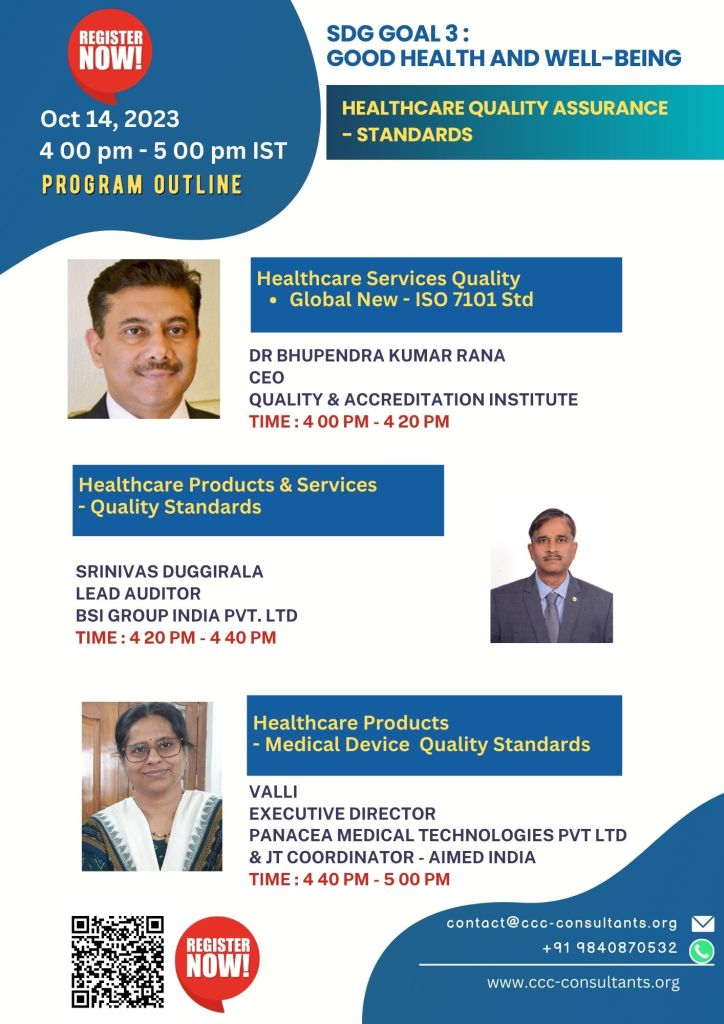
CCC(Consultants Consortium of Chennai) and MSCC(Management Systems Consultants Consortium) are organising a webinar on Oct 14th 2023 from 4 pm–5 pm.🗓️

WSD Theme this year : Shared Vision for a better World – Incorporating SDG 3

SDG 3 is all about Good Health and Wellbeing 👩🏻‍⚕️

In alignment with Global Theme,we have scheduled a webinar on the following topic:

Healthcare Quality Assurance – Standards ✅

ISO has released a Healthcare QMS Std – ISO 7101, for the first time globally.🏥
Pharma Sector is witnessing Global MS Standards in Pharma Manufacturing as well💊
Medical Devices Sector is racing towards implementing MDQMS 🩺

Session on Healthcare Quality Assurance is designed to Educate Healthcare Sector – be it Services or Products , and various other stakeholders, about various Healthcare Quality Assurance Standards which are introduced globally to improve the Healthcare Quality Focus across the globe.

Healthcare Services can’t offer Assurance on its Quality when its Supply Chain, Value Chain Quality is not in alignment with its Quality Assurance Framework.

Time to LEARN, UNLEARN and RELEARN 🧑‍🎓

Prog Info :

Date : Oct 14, 2023
Time : 4 pm – 5 pm
Meeting Mode : Zoom Meeting
Fee – No Fee. Free for all 🆓

Registration Link :https://us02web.zoom.us/meeting/register/tZwsd-uhrD8rHdXTn3awk0eCxcSxAzqqSg20

Prior registration is a must. All registered delegates will receive direct mail from ZOOM, CCC Secretariat and also a SMS.

For Prog info, updates, visit – https://ccc-consultants.org/world-standards-day-2023/

For queries , pls mail :

CCC – contact@ccc-consultants.org
MSCC – info@msccglobal.com

World Standards Day (WSD)

World Standards Day is celebrated globally on Oct 14 every year.

Global Theme for this year is on: Shared vision for better world: Incorporating SDG 3 (Good Health and Well Being)

Quality and Accreditation Institute (QAI) is Celebrating WSD 2023 by organising a one Hour Session based on the Global Theme on 14 October 2023 between 11 AM to 12 PM.

The session will be held in Virtual Mode (Webinar).

Registration Link: https://us02web.zoom.us/meeting/register/tZ0vceGhrzwqHdRVwoCTgdFgh559fLKH8pVN

After registering, you will receive a confirmation email containing information about joining the meeting.

Join hands to celebrate the day.

DRAFT FRAME WORK FOR ACCREDITATION AND RANKING OF COLLEGES REGULATED BY NMC

Starting from the 2024-25 academic session, all medical colleges in the country, both private and public, will mandatorily be rated and ranked. The move follows a Memorandum of Understanding (MoU) signed by the National Medical Commission (NMC) with the Quality Council of India (QCI) to rate medical institutions.

An MoU between the NMC, the medical education regulator, and the QCI was signed recently to this effect

NABL Document Review Checklist

NABL Document Review Checklist as per ISO 15189:2022 Standard

National Accreditation Board for Testing and Calibration Laboratories (NABL) has released Document Review Checklist (NABL 220D) based on ISO 15189:2022 Standard

All NABL Lead assessor is required to review the information provided by the laboratory in line with NABL policies relevant to applicant medical testing laboratories and provide their remarks / comments on the overall completeness of the information on the application forms and the management system document in conformance with the requirements of ISO 15189: 2022 standard.

Lead assessor is required to submit the Document Review Report (DRR) directly to NABL within 10 days along with duly filled Form-74 ‘Declaration of Impartiality and Confidentiality’.

Source:https://nabl-india.org/

NABH – LATEST NOTIFICATIONS

Latest Notifications Issued by NABH on Hospital Accreditation Standards

NOTIFICATION FOR SMALL HEALTH CARE ORGANIZATIONS

NABH has started implementation of 3rdedition accreditation standards for SHCOs w.e.f. 1st March 2023.

In view of multiple representations received from various stakeholders and our endeavour to continue conducting comprehensive assessments of SHCOs, NABH has decided to increase number of man-days for conducting the mid-term surveillance assessments of SHCOs under 3rd edition, from current 1*1 (1 assessor for 1 day) to 2* 2 (2 assessors for 2 days) with immediate effect.

There shall be no change in the number of man-days for final and re-assessments of SHCOs.

Source: https://nabh.co/Announcement/Notification%20for%20Change%20in%20Man-days%20for%20Surveillance%20assessment%20of%20SHCOs.pdf

NOTIFICATION FOR FEEDBACK ON 5th EDITION ACCREDITATION STANDARDS FOR HOSPITALS

NABH will soon be initiating drafting of 6th edition of Hospital Accreditation Standards in accordance with ISQua EEA Guidelines. You are requested to give feedback on the current NABH Standards i.e. 5th Edition. Your feedback/ inputs will add value in developing new edition of Hospitals standards.

The comments are invited on the following link.

Feedback form: https://forms.gle/5TXp5PsymacUR3Mu8

The last date for receiving feedback is 15th May, 2023.

Source: https://nabh.co/Announcement/Notification%20for%20Feedback%20on%205th%20Edition%20Standard.pdf

NABH Notification

NABH – DIGITAL HEALTH ACCREDITATION STANDARDS – (DRAFT)

NABH has released the Draft standard – Digital Health Accreditation Standards – 1st Edition.

NABH invites comments, suggestions and feedback in the draft document from public at large, including the stakeholders like hospitals the other clinical establishments, industry, consumer groups etc.

The comments may be shared on the form within 20 days of publication of this notice on the website.

Please find the Link for google form link to submit the feedback.

https://forms.gle/wSCKTJnfbDwvnase7

The last date for receiving comments is 2nd May 2023

Source:https://nabh.co/Announcement/Public%20Notice%20for%20Digital%20Health%20Standard%201st%20Edition.pdf