Industry Update – MoHFW Notification

Ministry of Health and Family Welfare has released a gazette notification notifying the new rules that may be called the Drugs and Cosmetics (Compounding of Offences) Rules, 2025. The rules are framed by the Central Government using the powers conferred by the Drugs and Cosmetics Act, 1940.

The notification introduces rules under an existing act, under section 33 of the Drugs and Cosmetics Act, 1940 (23 of 1940).

These rules provide a framework for “compounding of offences” under the Drugs and Cosmetics Act, 1940. This means that instead of going through full prosecution, certain offences might be resolved by paying a specified amount (compounding amount). The rules outline the process for applying for compounding, the authorities involved, and the conditions for granting immunity from prosecution.

Key highlights of the Drugs and Cosmetics (Compounding of Offences) Rules, 2025 notification:

Compounding of Offences: The primary focus is to establish rules for compounding certain offences under the Drugs and Cosmetics Act, 1940, offering an alternative to traditional prosecution.  

Application Process: The rules detail how an applicant (a company or person involved in the pharma industry) can apply for compounding of an offence. This can be done before or after prosecution begins.  

Compounding Authority: The notification defines the “compounding authority” and how they are appointed by the Central or State Government to manage the compounding process.  

Procedure: It outlines the step-by-step procedure the compounding authority must follow, including gathering reports and making decisions on whether to allow compounding.  

Immunity from Prosecution: The rules explain the conditions under which the compounding authority can grant immunity from prosecution to an applicant.  

Withdrawal of Immunity: The notification also specifies the circumstances under which this granted immunity can be withdrawn.  

Form for Application: The inclusion of a specific form for applying for compounding of offences

Why the need for “Compounding of Offences” ?

The Jan Vishwas (Amendment of Provisions) Act, 2023, aims to decriminalize various offenses in 42 Central Acts, enhancing ease of doing business and living by reducing compliance burdens. It accomplishes this by removing imprisonment and/or fines in many provisions, replacing them with penalties or enhancing existing fines. 

Key features and objectives of the Jan Vishwas Act include:

  • Decriminalization:The Act decriminalizes 183 provisions across 42 Central Acts, which are administered by 19 Ministries/Departments. 
  • Enhanced Ease of Doing Business:The Act aims to simplify compliance for businesses by removing or modifying existing criminal penalties. 
  • Trust-Based Governance:By decriminalizing certain offenses, the Act seeks to foster a more trust-based environment for businesses. 
  • Pragmatic Penalties:The Act introduces mechanisms for adjudicating officers and appellate authorities, ensuring penalties are commensurate with the severity of the offense. 
  • Flexibility in Enforcement:The Act allows for compounding of certain offenses, providing an alternative to full-fledged prosecution. 
  • Focus on Specific Acts:The Act addresses provisions in various Acts, including those related to intellectual property, media, and other sectors. 

Drugs and Cosmetics Act, 1940 Amendment: The Drugs and Cosmetics Act, 1940 is one of the acts amended by the Jan Vishwas Act.

Implementation of Jan Vishwas Act’s Intent: The Drugs and Cosmetics (Compounding of Offences) Rules, 2025, can be seen as a mechanism to implement the changes brought about by the Jan Vishwas Act to the Drugs and Cosmetics Act, 1940. It provides the specific procedures and framework for how these offenses will be dealt with, in alignment with the intent of decriminalization and promoting ease of doing business.

Overall, the Jan Vishwas Act aims to create a more business-friendly and less punitive environment by decriminalizing certain offenses and rationalizing legal provisions across various sectors. 

Hence the new Rules on Compounding of Offences under Drugs & Cosmetics Act may have originated from the recent amendments made to Jan Vishwas (Amendment of Provisions) Act 2023.

In essence, the Jan Vishwas Act provides the legislative amendment to allow for decriminalization, and the Drugs and Cosmetics (Compounding of Offences) Rules, 2025, provides the procedural rules for implementing that change through compounding of offenses.

Industry Update – Revision of Risk based Classification of Medical Devices – CDSCO

Central Drugs Standard Control Organisation (CDSCO) has revisited the existing risk based classification of Medical Devices in the categories of Cardiovascular and Neurological and added new entries based on their classification as per the First Schedule (Part I) of the MDR 2017

In this regard, CDSCO has issued a notification dated 1st April 2025, inviting all Stakeholders in the Medical Devices sector, such as Healthcare professionals, Manufacturers, Policymakers, Regulatory bodies, and other entities involved in the classification and regulation of medical devices to review the draft document and provide feedback within 30 days of publication to refine the risk-based classification framework for medical devices.

All concerned associations/stakeholders are requested to forward your comments by filling the Google form at https://forms.gle/62xF3BtXWC5pgD3TA within 30 days from the date of publication of this draft.

Source: https://cdsco.gov.in/opencms/opencms/system/modules/CDSCO.WEB/elements/download_file_division.jsp?num_id=MTI2MjM=

Industry Update – Application Process for Seeking Extension of Schedule M

The Central Drugs Standard Control (CDSCO) has issued a Circular on 24th March 2025, that an online portal ONDLS has been launched for submission of application for extension of the timeline to comply with Schedule M by Small and Medium Manufacturers.

Small and Medium manufacturers with turnover of less than Rs.250 crores, can submit an application within 3 months of this notification in Form A (plan of upgradation) to the Central License Approving Authority for extension of implementation till 31st December 2025.

In this regard, CDSCO has developed an online system for submiting application through ONDLS portal.

The applicant / manufacturer seeking extension of the timeline has to register on the ONDLS portal and thereafter submit an application.

No hard copy of the application for seeking extension will be considered.

Circular of CDSCO is given below :

Source: https://statedrugs.gov.in/SFDA/ondls-login.html

Industry Update – Guidance Document

Indian Council of Medical Research (ICMR) in coordination with Central Drugs Standard Control Organisation (CDSCO) has published a Guidance Document on Validation of Rapid Diagnostics for Pathogen Identification and Antimicrobial Susceptibility Testing (AST)

This document provides guidance for innovators and testing laboratories on validating diagnostics for pathogen identification and antimicrobial susceptibility testing.

It outlines a systematic framework to evaluate diagnostic performance, focusing on precision, accuracy, reproducibility, and the ability to detect target pathogens or their genetic materials (e.g., DNA, RNA, toxins, or antigens).

It also includes methods for antimicrobial susceptibility testing and prepares developers for the validation process by detailing evidence requirements and regulatory approval pathways.

Prepared by the AMR Coordination Unit of ICMR, this third draft incorporates expert feedback and inputs from the Central Drugs Standard Control Organization (CDSCO).

The document is designed to evolve with advancements in technology and methodologies, ensuring reliable diagnostics for clinical decision-making.

Source: https://www.icmr.gov.in/icmrobject/uploads/Guidelines/1736941384_guidancedocument_amrdiagnostics_revised.pdf

Industry Updates : Import of refurbished medical devices are not allowed – CDSCO

Central Drugs Standard Control Organisation (CDSCO) regulates Quality, Safety and Performance of the Medical Devices under Drugs and Cosmetics Act, 1940 and Medical Devices Rules 2017.


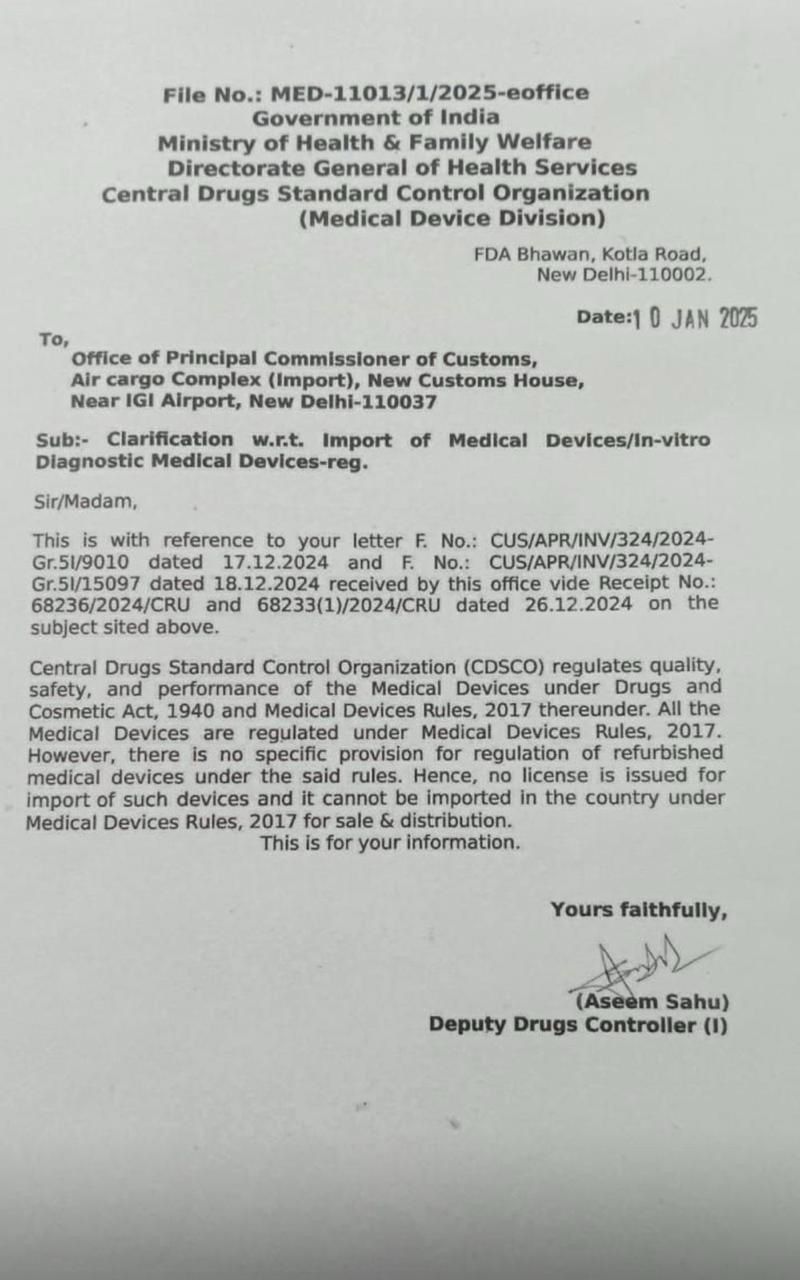
To control the second-hand / unregulated medical devices in the country, recently CDSCO has issued a letter to the Principal Commissioner of Customs, New Delhi, clarifying that No separate license is issued for import of refurbished medical devices in the country. Following points are covered in the communication

  1. All the Medical Devices are regulated under Medical Devices Rules 2017
  2. However, there is no specific provision for regulation of refurbished medical devices under the said Medical Devices Rules 2017         
  3. Hence no license is issued for import of such devices and it cannot be imported in the country under Medical Devices Rules 2017 for sale and distribution.

Industry Update – Standard IVD Evalution protocols

Indian Council of Medical Research (ICMR) and the Central Drugs Standard Control Organization (CDSCO) have jointly issued the Draft Standard IVD Evaluation Protocols

The document outlines the need for standardized evaluation protocols for IVDs as mandated by the Medical Devices Rules 2017. These protocols are essential to ensure the quality and performance of diagnostic kits used in India

Several specific performance evaluation protocols have been drafted, including those for:

a. Chikungunya IgM ELISA
b. Dengue NS1 RDT and ELISA
c. Zika virus real-time PCR , among others

The document includes detailed guidelines for evaluating various IVDs, emphasizing:

i. Study design and ethical considerations
ii.Requirements for evaluation sites and laboratory standards
iii.Procedures for conducting diagnostic accuracy studies
iv.Acceptance criteria for sensitivity and specificity of tests.

This initiative by ICMR and CDSCO aims to enhance the reliability of diagnostic testing in India through structured evaluation processes, ensuring that manufacturers adhere to high standards of quality in their products. Stakeholder engagement is critical to refining these protocols before their final adoption.

Stakeholders are invited to provide comments on these protocols until February 15, 2025.

Comments should be submitted via email before 15th February 2025, at ivdevaluation@gmail.com as per the specified format given in the notification

Source: https://www.icmr.gov.in/icmrobject/uploads/WhatsNew/1735801120_advt_ivd_document.pdf

Industry Update

CDSCO (Central Drugs Standard Control Organisation) has issued a Circular on 22nd May 2024 relating to the Blood Centre Situated in Hospital or Hospital Campus.

It is clarified that the Blood Centre run by the Hospital means the Blood centre situated in the Hospital premises. Application for grant / renewal of license for blood centre by a Hospital will be considered accordingly.

Further as per Provision under rules 122-G of the Drug Rules, 1945, applications for grant or renewal of license will be continued to be accepted by the State Drugs Department and the CDSCO for operation of Blood Centre or processing of Human Blood components run by Government, Indian Red Cross Society, Hospital, Charitable Trust or Voluntary Organisation.

Source: https://cdsco.gov.in/opencms/opencms/en/Notifications/Circulars/

CDSCO mandates online safety reporting

CDSCO mandates online safety reporting for Medical Devices

Following pharmaceuticals, the Central Drugs Standard Control Organisation (CDSCO) has mandated that manufacturers of medical devices and in-vitro devices submit their safety reports online.

The Drugs Controller General of India, has issued the directive on 19th March 2024 for online submission of Period Safety Update Reports for Medical Devices and in-vitro devices, aimed at improving post-market surveillance data evaluation

Effective 1 April 2024, the option to submit applications offline in hard copy or any other method will no longer be available

A PSUR is a vital pharmacovigilance document that assesses the risk-benefit balance of a drug product after its authorization, providing a comprehensive analysis based on all available information, including new data.
This report determines whether additional studies are necessary or if modifications are needed

This is part of efforts to overhaul India’s drug regulation framework and enhance safety transparency.

Source: https://cdsco.gov.in/opencms/opencms/en/Latest-Circulars/
https://www.livemint.com/

Regulatory Guidelines for Sampling of Drugs

Drugs Inspectors of Central & State Drug Authorities have released the guidance document for sampling of drugs, cosmetics & medical devices vide their circular dated 9th feb 2024.

This guideline is mainly focused to utilize available information & identified risks for selection of sample & location to cover vast variety of drugs, cosmetic and medical devices moving in the market from manufacturing facility, wholesale outlet, retail outlet, government distribution channel etc.

This guideline will be useful for effective surveillance for quality & efficacy of drugs & cosmetic available in the market by adopting uniform drug sampling methodology for drugs inspectors under drug regulatory authorities of state and central.

The main objective of the sampling is to check the quality & efficacy of drugs & cosmetic available in the market with their approved specifications. This involves:

 Monitoring the quality of the API, Excipients and finished products of drugs, cosmetic and medical devices in all parts of the distribution chain throughout the authorised shelf-life.
 Ensuring that existing control methods are satisfactory.
 Investigating the Not of Standard Quality (NSQ) Product.
 Identifying Unapproved Products/ Without License sales outlets.
 Identifying Spurious drugs in distribution chain
 Identifying sales outlets where repetitive NSQ/ Spurious drugs are reported etc

Source: https://cdsco.gov.in/opencms/opencms/en/Home/

AMD – CF schemes for Medical Device Clusters

The Ministry of Chemicals & Fertilizers Department of Pharmaceuticals has issued the Guidelines for the Scheme for “Assistance to Medical Device Clusters for Common Facilities (AMD-CF)” on May 9 ,2023 with a proposed financial outlay of Rs. 300 crore

About AMD-CF Scheme

AMD-CF Scheme aims to strengthen the existing and new medical device clusters by providing financial assistance for setting up new testing laboratories for medical devices ensuring quality and sustainable growth for the sector

The Scheme further intends to support Central or State Government/s or Institutions or Organization to establish or strengthen the Testing Laboratories for Medical Devices to meet the needs arising due to roll out of the licensing regime of the MDR, 2017 and ensuring availability of more testing facilities for evaluation of Medical Devices on behalf of the manufacturers, as mandated under MDR, 2017 or as per the amendment thereon, from time to time

The Scheme would be implemented in a Public Private Partnership (PPP) mode through one time grant-in-aid for creation of infrastructure and common facilities. A Special Purpose Vehicles (SPVs) will be set up for this purpose. The SPVs will have a minimum of 3 pharma units (including Bulk Drug and Medical Device Units) as its shareholders. There shall be a minimum of five medical device manufacturing units as members of SPV.

The SPV should have representatives from cluster members, financial institutions, state and central government and R&D organisations and the individual manufacturing unit cannot hold more than 40 per cent in the SPV. The Medical Devices enterprises shall hold at least 51 per cent equity of the SPV

The outcomes of the Scheme will be reviewed after 2 years from the date of its initiation.

SIDBI has been appointed as Project Management Agency (PMA) for implementation of Scheme.

Components / Sub schemes of AMD – CF Scheme

There are two components / sub schemes to this AMD – CF scheme :

1. Assistance for Common Facilities (CF) : To strengthen the medical device clusters’ capacity for their sustained growth by creating Common Infrastructure Facilities.
2. Assistance for Testing Facilities (TF) : To strengthen availability of more Medical Device Testing Laboratories in order to boost manufacturing of quality medical devices

Financial outlay of the Schemes :

The sub-schemes are designed to set up 12 common facilities and 12 testing laboratories, under which the common facilities will be supported with a financial assistance of Rs. 240 crore for the common facilities and Rs. 60 crore for the testing facilities

Tenure of the Scheme :

The tenure of the Scheme is from Financial Year 2023-24 to Financial Year 2026-27.

Incentives Under this Scheme :

For Common Infrastructure Facilities (CIF) for the Medical Device (MD) clusters: the limit of support will be 70% of the approved project cost or Rs. 20 cr., whichever is less, as per the approval of SSC (Scheme Steering Committee). In the case of Himalayan States and States in the North East Region, the grant-in-aid would be Rs. 20 Crore per Cluster or 90% of the project cost of the CIF, whichever is less

For Testing Facilities (TF) of Medical Device (MD) products,the limit of support will be 70% of the approved Testing Facilities project cost or Rs. 5 cr., whichever is less, as per the approval of SSC.

In the case of Himalayan States and States in the North East Region, the grant-in-aid would be Rs. 5 Crore per Cluster or 90% of the project cost of the CIF, whichever is less.

Any expenditure above the prescribed limit shall be borne by the elected applicant

Benefits of the Sub Schemes are :

i. Improvement in quality standards of medical devices
ii. Improvement in regulatory compliance specified for medical device
iii.Increased availability of trained personnel for Medical Devices clusters
iv.Increased competitiveness of Medical Devices units in cluster
v. Reduction in the manufacturing cost of Medical Devices

Notice for Invitation of Applications:

The Department has now invited applications from eligible applicants under the Scheme AMDCF.

The eligible applicants may apply through online mode only. The link is https://amdcf.udyamimitra.in/.

The detailed guidelines of the Scheme is available at https://pharmaceuticals.gov.in/schemes.

The last date for filing of the application is 10.02.2024.