NABH MITRA PROGRAM – Launch

The NABH MITRA Empanelment Programme has been officially launched to build a nationwide network of verified professionals and organisations (“MITRAs”) who will support hospitals with NABH Accreditation, Certification, and digital health transformation, especially across Tier 2, 3, and 4 cities in India.

The last date to submit applications for empanelment is October 10,2025

About the Programme

The initiative offers a structured, transparent framework for MITRAs—trusted companions to hospitals—who will guide healthcare organisations through quality improvement and digital enablement in line with NABH standards. Empanelled MITRAs will be listed on the NABH website with verified credentials and areas of expertise.

Categories of MITRAs

Digital MITRA: Supports hospitals in implementing NABH Digital Health Standards and IT enablement through structured digital health consultancy. Digital MITRA category has additional training and experience requirements

Organisational MITRAs: Support hospitals for both Full Accreditation and Entry-Level Certification.

Individual MITRAs: Independently support hospitals mainly for Entry-Level Certification.

Who Can Apply:

Individual MITRAs: Qualified professionals with at least one successful accreditation or certification support project and one NABH-certified professional (current assessors not eligible).

Organisational MITRAs: Registered companies, LLPs, trusts, societies, or proprietorship entities operational for at least one year, with experience supporting minimum three hospitals through accreditation or certification. Must have at least two NABH-certified professionals (current NABH assessors not eligible).

Application Process & Fees

i. Apply via the NABH online portal by October 10, 2025.
ii. Shortlisted candidates will be invited for interviews and required training.
iii.Empanelment fee for a three-year period: ₹20,000 + GST (Individual MITRA), ₹50,000 + GST (Organisational MITRA).
iv.Training program charges: ₹25,000 + GST for MITRA, ₹15,000 + GST for Digital MITRA (paid after selection)

Additional Information

i. MITRAs will play a key role in enabling hospitals to achieve NABH standards and strengthen India’s healthcare quality framework
ii. Empanelment does not imply endorsement or financial association by NABH.
iii.Maintaining high standards, transparency, and ethical conduct is compulsory.

Source: https://portal.nabh.co/Announcement/MEP_Concept.pdf

Industry Information update : Sector-wise Compendiums of Indian Standards

BIS Unveils 130 Sector-wise Compendiums of Indian Standards to Enhance Industry and Consumer Awareness

The Bureau of Indian Standards (BIS) has released a comprehensive collection of 130 sector-specific compendiums of Indian Standards, now accessible on the BIS portal.

Organized by industry sectors and product/service categories, these compendiums serve as consolidated reference guides for a wide range of stakeholders, including regulatory authorities, industry professionals, academic institutions, and consumer organizations.

Stakeholders can access the compendiums at
https://services.bis.gov.in/php/BIS_2.0/bisconnect/compendium_of_indian_standards_dept_wise

Please scan the QR code given below to download :

Source: https://services.bis.gov.in/php/BIS_2.0/bisconnect/compendium_of_indian_standards_dept_wise

Industry update: Constitution of Medical Device related adverse Event Committee in Medical Colleges

The National Medical Commission (NMC) public notice, dated July 13, 2025, addresses the monitoring, assessment, and prevention of adverse events associated with medical devices through the constitution of a Medical Device related Adverse Event Committee (MDAEC) in each medical college.

Here’s a breakdown of the advisory:

Intent of the Advisory:

The core intent of this advisory is to enhance patient safety and improve the quality of healthcare delivery by systematically collecting, analyzing, and responding to adverse events related to medical devices. It acknowledges that medical devices are crucial in modern healthcare but can cause harm, necessitating a robust monitoring system. The advisory emphasizes the integration of medical colleges into the Materiovigilance Programme of India (MvPI), launched in 2015 by the Ministry of Health and Family Welfare (MoHFW), to monitor these adverse events and risks nationwide. This program aims to provide data to the Central Drugs Standard Control Organization (CDSCO) to support regulatory action and guide improvements in clinical practice.

Role of Medical Colleges:

Medical colleges are identified as ideal hubs for Materiovigilance due to their diverse patient populations and access to advanced healthcare technologies.

The advisory outlines several strategic advantages for medical colleges becoming a Medical Device Adverse Events Monitoring Centre (MDMC), including:

Academic Recognition: Enhancing the institution’s stature as a contributor to national public health and regulatory science.
Professional Development: Providing faculty and students hands-on exposure to post-market surveillance, risk assessment, and patient safety.
Infrastructure Enhancement: Gaining access to MvPI resources, training modules, and national-level collaboration.
Policy Influence: Offering opportunities to contribute to evidence-based recommendations and medical
device regulations.
Patient Safety: Ensuring early detection and response to device malfunctions, directly improving clinical outcomes.

Key Directives for Medical Colleges:

The advisory mandates the following actions for all medical institutions:

Establishment of MDAEC: Each medical institution is advised to set up a committee to monitor adverse events related to medical devices.
Registration with IPC: This committee must be registered with the Indian Pharmacopoeia Commission (IPC). The enrollment form is available on the IPC website.
Website Disclosure: The medical institution’s website must indicate the name of the Coordinator/Convenor and additional members of the committee.
Chairperson: The Medical Superintendent will ordinarily be the Chairperson of this committee.
Registration Date: The website should also indicate the date of MDAEC registration.
Pharmacovigilance Committee Update: Institutions are also reminded to update the names of Pharmacovigilance Committee members on their website.

Timeline: This process has to be completed before July 31, 2025.

Source:https://www.nmc.org.in/MCIRest/open/getDocument?path=/Documents/Public/Portal/LatestNews/Public%20Notice%20dt%2013-07-2025.pdfhttps://www.nmc.org.in/MCIRest/open/getDocument?path=/Documents/Public/Portal/LatestNews/Public%20Notice%20dt%2013-07-2025.pdf

Industry Update – MoHFW Notification

Ministry of Health and Family Welfare has released a gazette notification notifying the new rules that may be called the Drugs and Cosmetics (Compounding of Offences) Rules, 2025. The rules are framed by the Central Government using the powers conferred by the Drugs and Cosmetics Act, 1940.

The notification introduces rules under an existing act, under section 33 of the Drugs and Cosmetics Act, 1940 (23 of 1940).

These rules provide a framework for “compounding of offences” under the Drugs and Cosmetics Act, 1940. This means that instead of going through full prosecution, certain offences might be resolved by paying a specified amount (compounding amount). The rules outline the process for applying for compounding, the authorities involved, and the conditions for granting immunity from prosecution.

Key highlights of the Drugs and Cosmetics (Compounding of Offences) Rules, 2025 notification:

Compounding of Offences: The primary focus is to establish rules for compounding certain offences under the Drugs and Cosmetics Act, 1940, offering an alternative to traditional prosecution.  

Application Process: The rules detail how an applicant (a company or person involved in the pharma industry) can apply for compounding of an offence. This can be done before or after prosecution begins.  

Compounding Authority: The notification defines the “compounding authority” and how they are appointed by the Central or State Government to manage the compounding process.  

Procedure: It outlines the step-by-step procedure the compounding authority must follow, including gathering reports and making decisions on whether to allow compounding.  

Immunity from Prosecution: The rules explain the conditions under which the compounding authority can grant immunity from prosecution to an applicant.  

Withdrawal of Immunity: The notification also specifies the circumstances under which this granted immunity can be withdrawn.  

Form for Application: The inclusion of a specific form for applying for compounding of offences

Why the need for “Compounding of Offences” ?

The Jan Vishwas (Amendment of Provisions) Act, 2023, aims to decriminalize various offenses in 42 Central Acts, enhancing ease of doing business and living by reducing compliance burdens. It accomplishes this by removing imprisonment and/or fines in many provisions, replacing them with penalties or enhancing existing fines. 

Key features and objectives of the Jan Vishwas Act include:

  • Decriminalization:The Act decriminalizes 183 provisions across 42 Central Acts, which are administered by 19 Ministries/Departments. 
  • Enhanced Ease of Doing Business:The Act aims to simplify compliance for businesses by removing or modifying existing criminal penalties. 
  • Trust-Based Governance:By decriminalizing certain offenses, the Act seeks to foster a more trust-based environment for businesses. 
  • Pragmatic Penalties:The Act introduces mechanisms for adjudicating officers and appellate authorities, ensuring penalties are commensurate with the severity of the offense. 
  • Flexibility in Enforcement:The Act allows for compounding of certain offenses, providing an alternative to full-fledged prosecution. 
  • Focus on Specific Acts:The Act addresses provisions in various Acts, including those related to intellectual property, media, and other sectors. 

Drugs and Cosmetics Act, 1940 Amendment: The Drugs and Cosmetics Act, 1940 is one of the acts amended by the Jan Vishwas Act.

Implementation of Jan Vishwas Act’s Intent: The Drugs and Cosmetics (Compounding of Offences) Rules, 2025, can be seen as a mechanism to implement the changes brought about by the Jan Vishwas Act to the Drugs and Cosmetics Act, 1940. It provides the specific procedures and framework for how these offenses will be dealt with, in alignment with the intent of decriminalization and promoting ease of doing business.

Overall, the Jan Vishwas Act aims to create a more business-friendly and less punitive environment by decriminalizing certain offenses and rationalizing legal provisions across various sectors. 

Hence the new Rules on Compounding of Offences under Drugs & Cosmetics Act may have originated from the recent amendments made to Jan Vishwas (Amendment of Provisions) Act 2023.

In essence, the Jan Vishwas Act provides the legislative amendment to allow for decriminalization, and the Drugs and Cosmetics (Compounding of Offences) Rules, 2025, provides the procedural rules for implementing that change through compounding of offenses.

SEBI Notification

SEBI Notifications on the Position of Compliance Officer for Listed Entities

The Securities and Exchange Board of India (SEBI) has, through recent regulatory updates, significantly enhanced the role and responsibilities of the Compliance Officer within listed entities in India.

This post provides an analysis of the SEBI (Listing Obligations and Disclosure Requirements) (Third Amendment) Regulations, 2024, issued in December 2024, and the subsequent SEBI Circular dated April 1, 2025, which clarified certain aspects of these amendments. These regulatory actions highlights SEBI’s commitment to strengthening the corporate governance framework and ensuring robust compliance practices within listed entities.

The key changes mandate that the Compliance Officer must be a whole-time employee, hold a senior position not more than one level below the board of directors, and be designated as a Key Managerial Personnel (KMP). These requirements aim to empower the Compliance Officer, providing them with the necessary authority and access to effectively discharge their duties.

The April 2025 circular further clarifies the interpretation of the “level” of the Compliance Officer within the organizational structure, addressing ambiguities and ensuring consistent application of the regulations across different types of listed entities. These updates necessitate a re-evaluation of organizational structures and a greater emphasis on the strategic importance of the compliance function within listed entities.

II. SEBI (Listing Obligations and Disclosure Requirements) (Third Amendment) Regulations, 2024 (December 2024): Enhancing the Role and Position of the Compliance Officer

The SEBI (Listing Obligations and Disclosure Requirements) (Third Amendment) Regulations, 2024, were notified on December 12, 2024. This amendment, effective from the date of its publication in the Official Gazette on December 12, 2024 (with the exception of specific sub-regulations coming into force later) , signifies a determined effort by SEBI to reinforce the compliance framework within listed entities. The prompt implementation of these amendments suggests a recognition of the immediate need to elevate the stature and accountability of Compliance Officers.  

A pivotal aspect of this amendment is the revision of Regulation 6(1) of the LODR Regulations, which pertains to the appointment of a qualified company secretary as the compliance officer.

A new proviso has been inserted, stipulating that the Compliance Officer must be an officer in the whole-time employment of the listed entity. This requirement effectively prohibits the appointment of part-time compliance officers or external consultants, ensuring that the individual responsible for overseeing compliance is fully integrated within the company’s operations and dedicated to this critical function. This full-time commitment is expected to foster a deeper understanding of the company’s specific compliance needs and challenges, leading to more effective implementation of compliance policies and procedures.  

Furthermore, the amendment introduces a significant seniority requirement for the Compliance Officer, stating that they should not be more than one level below the board of directors. This elevation in the organizational hierarchy is intended to grant the Compliance Officer greater authority and access to the decision-making processes within the company. By positioning the Compliance Officer closer to the board, SEBI aims to ensure that compliance considerations are integrated at a higher level of management, thereby enhancing the overall culture of compliance within the listed entity. This also empowers the Compliance Officer to effectively communicate compliance-related concerns to the highest levels of management and facilitates quicker and more decisive action on compliance matters.  

In a move that further ignites the importance of the Compliance Officer role, the amendment mandates their designation as a Key Managerial Personnel (KMP). The concept of KMP is well-established under the Companies Act, 2013, and includes senior management personnel who have significant influence over the functioning of the company. Designating the Compliance Officer as a KMP aligns their responsibilities and potential liabilities with those of other key decision-makers such as the Managing Director (MD), Chief Executive Officer (CEO), and Chief Financial Officer (CFO). This designation reinforces the accountability of the Compliance Officer to the stakeholders and regulatory authorities for ensuring adherence to applicable laws and regulations, thereby elevating the significance of the role within the corporate structure.  

Recognizing the unique challenges faced by entities undergoing insolvency proceedings, the amendment introduces a new sub-regulation (1B) in Regulation 6. This provision specifically addresses vacancies in the office of the Compliance Officer for listed entities where a resolution plan has been approved under Section 31 of the Insolvency and Bankruptcy Code, 2016. It mandates that such vacancies must be filled within three months from the date of the resolution plan’s approval. Additionally, a proviso to this sub-regulation states that during any interim period where the Compliance Officer position is vacant, the listed entity must have at least one full-time KMP managing its day-to-day affairs. This demonstrates SEBI’s proactive approach to ensuring that a robust compliance framework is maintained even during periods of financial distress and corporate restructuring, minimizing the potential for regulatory lapses during such critical times.  

Beyond the specific enhancements to the Compliance Officer’s role, the December 2024 amendment also included the omission of Regulation 7(3). This deletion removes the previous requirement for listed entities to submit a compliance certificate to the stock exchange, which was to be signed by both the Compliance Officer and the authorized representative of the share transfer agent. This change suggests a potential shift in regulatory focus towards placing greater reliance on the individual responsibility of the Compliance Officer and other internal mechanisms for ensuring compliance, rather than a joint external certification. It could also indicate SEBI’s move towards streamlining compliance procedures and reducing potential redundancies.  

III. SEBI Circular on Clarification of Compliance Officer Position (April 2025): Defining the “Level”

Following the issuance of the December 2024 amendment, SEBI received queries from listed entities seeking clarity on the interpretation of the term “level” as used in the revised Regulation 6(1) of the LODR Regulations. To address these ambiguities and ensure consistent implementation of the new requirements, SEBI issued a circular on April 1, 2025, bearing the reference number SEBI/HO/CFD/PoD2/CIR/P/2025/47.  This circular provides a crucial clarification regarding the meaning of “one-level below the board of directors.” SEBI explicitly stated that this phrase refers to a position directly below the Managing Director (MD) or Whole-time Director(s) (WTDs) who are part of the Board of Directors of the listed entity. This clarification provides much-needed certainty for listed entities, particularly those with an MD or WTD on their board, ensuring a uniform understanding of the required reporting structure for the Compliance Officer. This removes potential inconsistencies in interpretation and facilitates smoother implementation of the amended regulations.  
Recognizing the diverse organizational structures prevalent among listed entities, the circular also provides specific guidance for companies that do not have an MD or a WTD. In such cases, SEBI clarified that the Compliance Officer cannot be positioned more than one level below the Chief Executive Officer (CEO), Manager, or any other individual responsible for heading the day-to-day affairs of the listed entity. This ensures that even in the absence of a traditional MD or WTD, the Compliance Officer still occupies a sufficiently senior position within the organizational hierarchy, maintaining the intended level of authority and access. This demonstrates SEBI's pragmatic approach in tailoring the regulatory requirements to accommodate different organizational models while upholding the core objective of ensuring a senior and empowered Compliance Officer.  

Furthermore, SEBI emphasized that this interpretation of the term “level” is in alignment with regulation 2(1)(o) of the LODR Regulations, which defines “key managerial personnel” by referencing section 2(51) of the Companies Act, 2013. This alignment between SEBI’s listing regulations and the broader corporate law framework in India reinforces the consistency and coherence of the regulatory landscape. By linking the seniority requirement for the Compliance Officer to the definition of KMP under the Companies Act, SEBI ensures a unified approach to identifying and positioning key managerial personnel within listed entities.  

IV. Impact and Implications for Listed Entities:

The December 2024 amendment and the subsequent April 2025 circular have profound implications for listed entities in India, primarily centered around the enhanced status and responsibility of the Compliance Officer. These regulatory changes collectively elevate the Compliance Officer’s role from a primarily administrative function to a more strategic and influential position within the organization. Listed entities are now expected to empower their Compliance Officers to play a more proactive role in ensuring regulatory adherence and fostering a strong culture of compliance. This shift reflects a growing global recognition of the critical importance of compliance in mitigating risks, maintaining investor confidence, and upholding the integrity of the capital markets.  

To comply with these new regulations, listed entities may need to undertake a comprehensive review and potential adjustment of their existing organizational structures. Companies where the Compliance Officer currently reports to a level of management more than one step below the board (or the MD/WTD or CEO/Manager in their absence) will need to restructure their reporting lines and responsibilities to meet the new seniority requirements. This may involve creating new reporting structures or redefining the roles and responsibilities of other senior management personnel to ensure the Compliance Officer has a direct reporting line to the appropriate authority.  

The designation of the Compliance Officer as a KMP carries significant implications in terms of increased accountability and potential liabilities under the Companies Act, 2013. Compliance Officers, now recognized as key decision-makers, will be subject to the same level of scrutiny and held to the same standards as other KMPs. This necessitates that individuals appointed to this role possess the requisite expertise, experience, and integrity to effectively discharge their responsibilities. Listed entities must ensure that their Compliance Officers are equipped with the necessary resources, authority, and support to fulfill their expanded mandate.  

Collectively, these changes are expected to significantly strengthen the overall compliance function within listed entities. A more empowered and senior Compliance Officer is likely to lead to the development and implementation of more robust and effective compliance programs. This proactive approach to compliance can help reduce the risk of regulatory violations, penalties, and reputational damage, ultimately contributing to better corporate governance and enhanced investor trust.

For many listed entities, the existing Company Secretary, if possessing the requisite qualifications and experience, is likely to be designated as the Compliance Officer, thus fulfilling both roles. However, the enhanced responsibilities and elevated seniority associated with the Compliance Officer role may lead to an increased workload for Company Secretaries. Companies should therefore assess the existing capacity and provide adequate support and resources to their Company Secretaries to enable them to effectively manage their expanded scope of responsibilities. This may include providing additional staff, training, or technological tools to assist in managing the increased demands of the combined role.  

V. Conclusion:

The SEBI (Listing Obligations and Disclosure Requirements) (Third Amendment) Regulations, 2024, and the subsequent clarification circular issued in April 2025, represent a significant step towards strengthening the corporate governance framework for listed entities in India. By mandating that the Compliance Officer be a whole-time employee, hold a senior position not more than one level below the board, and be designated as a Key Managerial Personnel, SEBI has unequivocally emphasized the critical importance of the compliance function. The clarification provided in the April 2025 circular regarding the interpretation of the term “level” further ensures consistency and clarity in the implementation of these regulations across all listed entities. It is now incumbent upon listed entities to adapt to these regulatory updates by reviewing their organizational structures, empowering their Compliance Officers, and fostering a strong culture of compliance to ensure continued adherence to regulatory requirements and maintain the trust of their investors.

Source : SEBI Circulars
Clarification on the position of Compliance Officer in terms of regulation 6 of the SEBI (Listing Obligations and Disclosure Requirements) Regulations, 2015 – April 1, 2025

https://www.sebi.gov.in/legal/regulations/dec-2024/securities-and-exchange-board-of-india-listing-obligations-and-disclosure-requirements-third-amendment-regulations-2024_89956.html – Dec 12, 2024


Industry update – Guidelines for Common Bio Medical Waste Treatment

The Guidelines for Common Biomedical Waste Treatment and Disposal Facilities (CBWTFs) were introduced by the Central Pollution Control Board (CPCB) under the Ministry of Environment, Forest and Climate Change (MoEF&CC), Government of India.

These guidelines aim to ensure the safe, scientific, and environmentally sound handling of biomedical waste generated by healthcare facilities.

CBWTF stands for Common Biomedical Waste Treatment and Disposal Facility. It is a centralized facility designed to collect, treat, and dispose of biomedical waste generated from healthcare facilities (such as hospitals, clinics, laboratories, etc.) within a specific region.

As the amount of biomedical waste continues to increase—especially after the COVID-19 pandemic—the need for centralized facilities that can efficiently serve multiple healthcare units has become more urgent. They are especially important for smaller healthcare units that lack the resources to treat waste independently. By standardizing procedures and encouraging centralized treatment, these guidelines help minimize health risks, environmental pollution, and legal non-compliance.

The guidelines establish standards for site selection, infrastructure requirements, waste collection, transportation, treatment, disposal, staff safety, and legal compliance.

Source: https://cpcb.nic.in/openpdffile.php?id=TGF0ZXN0RmlsZS80NDBfMTc0NDgwMDgzMl9tZWRpYXBob3RvMTA1MjUucGRm

Industry Update – Application Process for Seeking Extension of Schedule M

The Central Drugs Standard Control (CDSCO) has issued a Circular on 24th March 2025, that an online portal ONDLS has been launched for submission of application for extension of the timeline to comply with Schedule M by Small and Medium Manufacturers.

Small and Medium manufacturers with turnover of less than Rs.250 crores, can submit an application within 3 months of this notification in Form A (plan of upgradation) to the Central License Approving Authority for extension of implementation till 31st December 2025.

In this regard, CDSCO has developed an online system for submiting application through ONDLS portal.

The applicant / manufacturer seeking extension of the timeline has to register on the ONDLS portal and thereafter submit an application.

No hard copy of the application for seeking extension will be considered.

Circular of CDSCO is given below :

Source: https://statedrugs.gov.in/SFDA/ondls-login.html

Industry Update – MNRE notifies Revised Quality Control Order for Solar Photovoltaic Products

The Union Ministry of New and Renewable Energy (MNRE) has officially notified the Solar Systems, Devices, and Components Goods Order, 2025, which supersedes the previous Solar Photovoltaics, Systems, Devices, and Components Goods (Requirements for Compulsory Registration) Order, 2017.

This revised order was published in the Gazette of India on January 27, 2025, and will take effect 180 days from this date.

It encompasses regulations for Solar PV modules, inverters used in Solar PV applications, and storage batteries.

Key Highlights of the Order:

  1. Mandatory Standards:
    • All solar PV modules, inverters, and storage batteries must comply with the latest Indian Standards as specified by the Bureau of Indian Standards (BIS) and must carry the Standard Mark under a BIS license.
    • Minimum efficiency standards have been established:
      • 18% for Mono Crystalline Silicon and Thin-Film PV Modules.
      • 17% for Poly Crystalline Silicon PV Modules.
  2. Applicability:
    • The order applies to manufacturers, importers, distributors, retailers, sellers, and lessors of solar PV systems and components.
    • Products intended solely for export are exempt from these regulations.
  3. Certification and Enforcement:
    • The BIS will be responsible for granting licenses and enforcing compliance with the order. Market surveillance will be conducted by BIS or an agency designated by BIS in collaboration with MNRE.
  4. Concurrent Operation:
    • Existing licenses under the 2017 order will remain valid; however, renewals and new registrations will be governed by the 2025 order.
  5. Penalties for Non-Compliance:
    • Violations of this order will result in penalties as outlined in the Bureau of Indian Standards Act, 2016.
  6. Promoting Public Interest:
    • The updated standards aim to ensure that safe and high-performance solar products are available in India’s expanding renewable energy market.

The revised Quality Control Order reflects MNRE’s commitment to advancing high-quality solar photovoltaic products that align with India’s renewable energy goals.

This initiative is expected to enhance product reliability and safety while supporting innovation within the sector.

For further details, please visit MNRE website – http://www.mnre.gov.in/

Source: https://mnre.gov.in/en/notice/notification-for-solar-systems-devices-and-components-goods-order-2025/

Industry Update – Legal Metrology (Packaged Commodities) Rules, 2011 with amendments

The Ministry of Consumer Affairs, Food, and Public Distribution, Department of Consumer Affairs has issued The Legal Metrology (Packaged Commodities) Rules, 2011 with all amendments up to December 24, 2024.

It outlines the regulations for pre-packaged commodities in India, ensuring that consumers receive accurate information about the products they purchase. 

The rules apply to packages intended for retail sale but exclude certain categories such as:
(a) packages of commodities containing quantity of more than 25 kilogram or 25 litre
(b) cement, fertilizer and agricultural farm produce sold in bags above 50 kilogram
(c) packaged commodities meant for industrial consumers or institutional consumers

The document includes several key amendments to the Legal Metrology (Packaged Commodities) Rules, 2011, compared to earlier versions. ​ Here are some notable amendments:

  1. Consumer Definition Update:
    • The definition of “consumer” has been updated to align with the Consumer Protection Act, 2019. ​
  2. E-commerce Provisions:
    • Definitions for “E-commerce,” “E-commerce entity,” and “marketplace-based model of e-commerce” have been added. ​
    • E-commerce entities must ensure that mandatory declarations are displayed on their digital platforms. ​
  3. Retail Sale Price (MRP):
    • The format for declaring the maximum retail price has been standardized to ensure clarity and consistency. ​
  4. Unit Sale Price:
    • The requirement to declare the unit sale price in rupees, rounded off to the nearest two decimal places, has been introduced. ​
  5. QR Code Usage:
    • For electronic products, the use of QR codes to provide additional information such as the manufacturer’s address, common or generic name, and size/dimensions has been allowed. ​
  6. Packaging Size and Weight:
    • Specific packaging sizes for various commodities have been updated or added, such as for baby food, biscuits, edible oils, and more.
  7. Exemptions:
    • New exemptions have been introduced for certain packages, such as those containing loose commodities ordered through e-commerce channels and garments sold in loose or open form at the point of sale. ​
  8. Inspection and Testing:
    • Detailed procedures for inspecting and testing packages at the premises of manufacturers, packers, and dealers have been specified, including the use of statistical methods to determine compliance. ​
  9. Penalties and Compounding of Offenses:
    • The penalties for non-compliance have been updated, including specific fines for different types of offenses. ​
    • The sum for compounding offenses has been specified, with different amounts for retailers, wholesale dealers, manufacturers, and importers. ​
  10. Registration Requirements:
    • The process for registering manufacturers, packers, and importers has been clarified, including the requirement to provide a complete address and the option to register a shorter address. ​
  11. Declaration of Quantity:
    • The rules for declaring the net quantity of commodities have been refined, including the requirement to exclude the weight of wrappers and materials other than the commodity. ​
  12. Best Before/Use by Date:
    • The requirement to declare the “best before” or “use by” date for commodities that may become unfit for human consumption after a period of time has been emphasized. ​

These amendments aim to enhance consumer protection, ensure transparency, and adapt to the evolving marketplace, including the rise of e-commerce.

The e book of  Legal Metrology (Packaged Commodities) Rules, 2011 can be downloaded from https://doca.gov.in/lm-ebook/

source: https://doca.gov.in/lm-ebook/

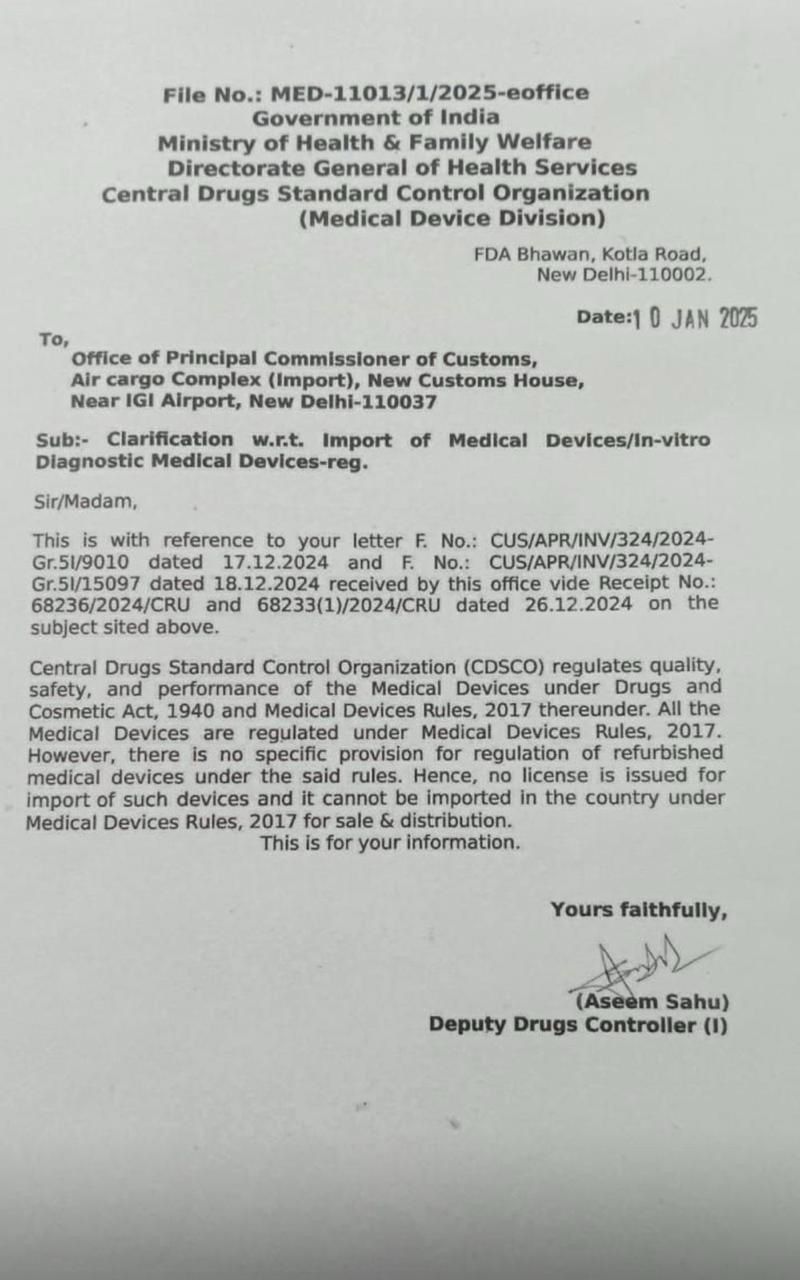
Industry Updates : Import of refurbished medical devices are not allowed – CDSCO

Central Drugs Standard Control Organisation (CDSCO) regulates Quality, Safety and Performance of the Medical Devices under Drugs and Cosmetics Act, 1940 and Medical Devices Rules 2017.


To control the second-hand / unregulated medical devices in the country, recently CDSCO has issued a letter to the Principal Commissioner of Customs, New Delhi, clarifying that No separate license is issued for import of refurbished medical devices in the country. Following points are covered in the communication

  1. All the Medical Devices are regulated under Medical Devices Rules 2017
  2. However, there is no specific provision for regulation of refurbished medical devices under the said Medical Devices Rules 2017         
  3. Hence no license is issued for import of such devices and it cannot be imported in the country under Medical Devices Rules 2017 for sale and distribution.