Application Process for Seeking Extension of Schedule M
The Central Drugs Standard Control (CDSCO) has issued a Circular on 24th March 2025, that an online portal ONDLS has been launched for submission of application for extension of the timeline to comply with Schedule M by Small and Medium Manufacturers.
Small and Medium manufacturers with turnover of less than Rs.250 crores, can submit an application within 3 months of this notification in Form A (plan of upgradation) to the Central License Approving Authority for extension of implementation till 31st December 2025.
In this regard, CDSCO has developed an online system for submiting application through ONDLS portal.
The applicant / manufacturer seeking extension of the timeline has to register on the ONDLS portal and thereafter submit an application.
No hard copy of the application for seeking extension will be considered.
MNRE notifies Revised Quality Control Order for Solar Photovoltaic Products
The Union Ministry of New and Renewable Energy (MNRE) has officially notified the Solar Systems, Devices, and Components Goods Order, 2025, which supersedes the previous Solar Photovoltaics, Systems, Devices, and Components Goods (Requirements for Compulsory Registration) Order, 2017.
This revised order was published in the Gazette of India on January 27, 2025, and will take effect 180 days from this date.
It encompasses regulations for Solar PV modules, inverters used in Solar PV applications, and storage batteries.
Key Highlights of the Order:
Mandatory Standards:
All solar PV modules, inverters, and storage batteries must comply with the latest Indian Standards as specified by the Bureau of Indian Standards (BIS) and must carry the Standard Mark under a BIS license.
Minimum efficiency standards have been established:
18% for Mono Crystalline Silicon and Thin-Film PV Modules.
17% for Poly Crystalline Silicon PV Modules.
Applicability:
The order applies to manufacturers, importers, distributors, retailers, sellers, and lessors of solar PV systems and components.
Products intended solely for export are exempt from these regulations.
Certification and Enforcement:
The BIS will be responsible for granting licenses and enforcing compliance with the order. Market surveillance will be conducted by BIS or an agency designated by BIS in collaboration with MNRE.
Concurrent Operation:
Existing licenses under the 2017 order will remain valid; however, renewals and new registrations will be governed by the 2025 order.
Penalties for Non-Compliance:
Violations of this order will result in penalties as outlined in the Bureau of Indian Standards Act, 2016.
Promoting Public Interest:
The updated standards aim to ensure that safe and high-performance solar products are available in India’s expanding renewable energy market.
The revised Quality Control Order reflects MNRE’s commitment to advancing high-quality solar photovoltaic products that align with India’s renewable energy goals.
This initiative is expected to enhance product reliability and safety while supporting innovation within the sector.
The Ministry of Consumer Affairs, Food, and Public Distribution, Department of Consumer Affairs has issued The Legal Metrology (Packaged Commodities) Rules, 2011 with all amendments up to December 24, 2024.
It outlines the regulations for pre-packaged commodities in India, ensuring that consumers receive accurate information about the products they purchase.
The rules apply to packages intended for retail sale but exclude certain categories such as: (a) packages of commodities containing quantity of more than 25 kilogram or 25 litre (b) cement, fertilizer and agricultural farm produce sold in bags above 50 kilogram (c) packaged commodities meant for industrial consumers or institutional consumers
The document includes several key amendments to the Legal Metrology (Packaged Commodities) Rules, 2011, compared to earlier versions. Here are some notable amendments:
Consumer Definition Update:
The definition of “consumer” has been updated to align with the Consumer Protection Act, 2019.
E-commerce Provisions:
Definitions for “E-commerce,” “E-commerce entity,” and “marketplace-based model of e-commerce” have been added.
E-commerce entities must ensure that mandatory declarations are displayed on their digital platforms.
Retail Sale Price (MRP):
The format for declaring the maximum retail price has been standardized to ensure clarity and consistency.
Unit Sale Price:
The requirement to declare the unit sale price in rupees, rounded off to the nearest two decimal places, has been introduced.
QR Code Usage:
For electronic products, the use of QR codes to provide additional information such as the manufacturer’s address, common or generic name, and size/dimensions has been allowed.
Packaging Size and Weight:
Specific packaging sizes for various commodities have been updated or added, such as for baby food, biscuits, edible oils, and more.
Exemptions:
New exemptions have been introduced for certain packages, such as those containing loose commodities ordered through e-commerce channels and garments sold in loose or open form at the point of sale.
Inspection and Testing:
Detailed procedures for inspecting and testing packages at the premises of manufacturers, packers, and dealers have been specified, including the use of statistical methods to determine compliance.
Penalties and Compounding of Offenses:
The penalties for non-compliance have been updated, including specific fines for different types of offenses.
The sum for compounding offenses has been specified, with different amounts for retailers, wholesale dealers, manufacturers, and importers.
Registration Requirements:
The process for registering manufacturers, packers, and importers has been clarified, including the requirement to provide a complete address and the option to register a shorter address.
Declaration of Quantity:
The rules for declaring the net quantity of commodities have been refined, including the requirement to exclude the weight of wrappers and materials other than the commodity.
Best Before/Use by Date:
The requirement to declare the “best before” or “use by” date for commodities that may become unfit for human consumption after a period of time has been emphasized.
These amendments aim to enhance consumer protection, ensure transparency, and adapt to the evolving marketplace, including the rise of e-commerce.
The e book of Legal Metrology (Packaged Commodities) Rules, 2011 can be downloaded from https://doca.gov.in/lm-ebook/
Webinar on Export of Environmental Services to Argentina and Brazil Programme by SEPC
Service Export Promotion Council (SEPC) is inviting participation from the industry in Webinar on Export of Environmental Services to Argentina and Brazil. Friday, 7-Feb- 2025 4:30PM to 6:00PM IST (8:00AM to 9:30AM BRT/ART)*
Embassy of India in Argentina and Brazil will be addressing the industry stakeholders of Environmental services sector
This exercise aims to strengthen the commercial ties between the industry members of both the countries promoting Indian exports in environmental sectors through dialogue, knowledge exchange and generation of strategic action plan for 2025-26.
Topics covered :
a.Investment opportunities in Brazil for Indian Environmental consultants. b.Any specific challenge in exporting to Brazil. c.Any specific competence of Indian workforce required to compete in Brazil. d.Suggest international fairs, expos, or virtual platforms for participation in Brazil. Program highlights :
▪Valuable insights into emerging opportunities and challenges in Environmental sector. ▪Opportunity to interact with distinguished speakers from the Embassies of both the countries.
This event is set to be a platform for the exchange of ideas and the development of cooperation strategies in this sector, consolidating India’s role as a strategic partner in Their economic sphere.
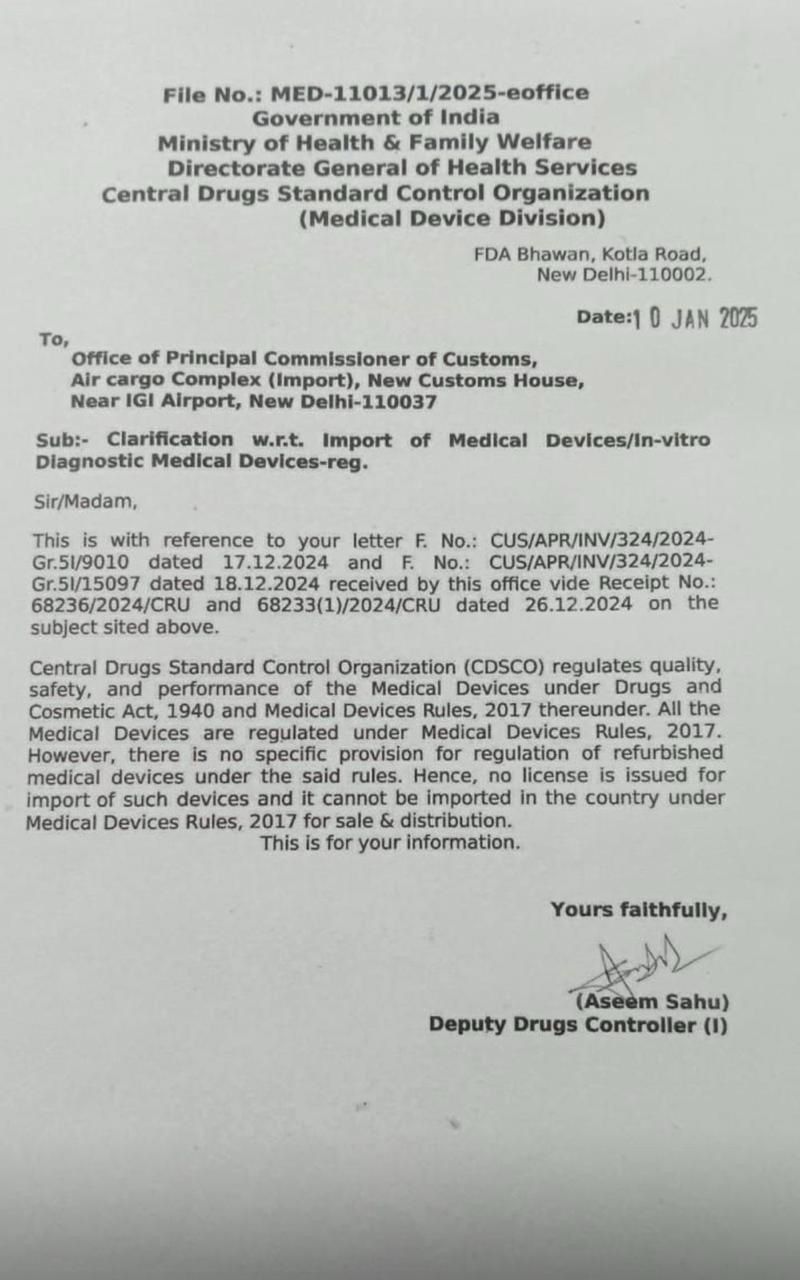
Import of refurbished medical devices are not allowed – CDSCO
Central Drugs Standard Control Organisation (CDSCO) regulates Quality, Safety and Performance of the Medical Devices under Drugs and Cosmetics Act, 1940 and Medical Devices Rules 2017.
To control the second-hand / unregulated medical devices in the country, recently CDSCO has issued a letter to the Principal Commissioner of Customs, New Delhi, clarifying that No separate license is issued for import of refurbished medical devices in the country. Following points are covered in the communication
All the Medical Devices are regulated under Medical Devices Rules 2017
However, there is no specific provision for regulation of refurbished medical devices under the said Medical Devices Rules 2017
Hence no license is issued for import of such devices and it cannot be imported in the country under Medical Devices Rules 2017 for sale and distribution.
ADVANCING TECHNOLOGY & INNOVATION IN INDIAN MEDICAL DEVICES AND ALLIED SECTORS
The Indian medical devices market has been identified as a sunrise sector by the Government of India, with its valuation anticipated to reach USD 50 Billion by 2030 Ernst & Young India; 26 Nov., 2024.
Notwithstanding the enormous growth potential of Indian medical device sector, its global market share is still fairly low with most of the domestic manufacturing focused on consumable and disposables, i.e. the lower end of technology value chain.
Realizing this, Government has identified medical devices sector as a priority area for the flagship ‘Make in India’ program and is committed to strengthen the manufacturing ecosystem through its ambitious initiatives
Technology and Development Board (TDB) has also, over the years, supported development and commercialization of socially and technologically relevant medical devices. In order to strengthen country’s priority sectors, TDB is launching the current ‘Call for proposal’ to supplement existing policy initiatives to bridge the current medium to high technology gap in Indian medical devices industry..
Technology Development Board invites proposals from Indian industrial concerns operating in medical devices and allied sectors to apply for funding support for product development/ manufacturing/scale-up; technology adaptation for new product development; medical device supply chain components; chemical and raw materials for diagnostics and kits; and product commercialization
Objectives of the Call for Proposal
I. Identify and act in areas requiring strategic interventions and develop socially relevant technologies by increasing access and universality to affordable and quality medical and healthcare devices.
II. Encourage production of competitive consumer products thereby reducing import dependence by supporting manufacturing and commercialization of medium to high technology medical devices.
III. Invest in core technological strengths to enable Indian industry to stand-up to the competitive pressure and accelerate country’s share of high-end, complex medical devices in global market.
Scope and focus areas
Diagnostics and Imaging devices: Including Radiology (both ionizing & non-ionizing radiation products); Nuclear Imaging Devices; Anesthetics & Cardio-Respiratory medical devices including catheters of cardio respiratory category; Renal Care medical devices; Artificial Intelligence based devices for detecting and monitoring lifestyle and other diseases.
Therapeutic and Prosthetics: Including cancer care/Radiotherapy devices; All Implants including prosthetic limbs/organs, implantable hearing aids/ear prosthesis; ophthalmic prosthetics (artificial eyeballs/cornea, eye socket replacements); voice prosthesis etc.
Regenerative therapy devices: Including cell therapies, immunomodulation therapies and tissue engineering (laboratory grown organs and tissues) related devices.
Medical equipment (others): All medical devices as classified under low risk (Class A) to high risk (Class D) categories in the Medical Devices Rules, 2017 and as detailed by Central Drugs Standard Control Organization on their website.
Eligibility Criteria:
Any Company incorporated under the Companies Act, 1956/the Companies Act, 2013.
A company intending to commercialize the technology.
All applications have to be submitted through online portal of TDB. The detailed information and the format for submission of the proposal may be downloaded from the official website: https://tdb.gov.in/
For queries and further details contact:
Dr. Richa Panwar Sr. Project Coordinator Technology Development Board https:/tdb.gov.in/ Email: richa.panwar@tdb.gov.in
Starting date of call for Proposal: December 16, 2024
On December 12, 2024, India marked a significant milestone in its journey toward decarbonizing the steel sector by unveiling the Taxonomy of Green Steel.
The Taxonomy of Green Steel is a pioneering effort by India, as it is the first nation to establish a formal definition of “green steel,” amid a global lack of consensus on the concept
Green Steel is defined based on its CO2 equivalent emission intensity, specifically for steel produced with emissions less than 2.2 tonnes of CO2 equivalent per tonne of finished steel (tfs). The greenness percentage is determined by how much lower a plant’s emissions are compared to this threshold.
Key features of the taxonomy include:
Rating System
Steel is rated based on its emission intensity:
Five-star green-rated steel: Emission intensity less than 1.6 t-CO2e/tfs.
Four-star green-rated steel: Emission intensity between 1.6 and 2.0 t-CO2e/tfs.
Three-star green-rated steel: Emission intensity between 2.0 and 2.2 t-CO2e/tfs.
Steel with emissions above 2.2 t-CO2e/tfs is not eligible for any green rating.
Review and Scope
The thresholds for star ratings will be reviewed every three years.
The emissions considered include Scope 1, Scope 2, and limited Scope 3, which encompasses various processes related to steel production but excludes upstream mining and downstream transportation emissions.
Certification Process
The National Institute of Secondary Steel Technology (NISST) is designated as the nodal agency responsible for measuring, reporting, and verifying emissions, as well as issuing greenness certificates and star ratings.
A registration fee of ₹10,000 will be charged per steel plant, with an additional certification fee of ₹1,000 for every 500 tonnes of finished steel certified.
Technical Explanation
The notification includes a technical appendix that explains how to calculate the greenness percentage based on actual emission intensity compared to the defined threshold.
This framework aims to promote sustainable practices in the steel industry by encouraging lower carbon emissions and providing a clear certification process for producers.
This initiative underscores India’s commitment to reducing emissions in its steel industry as part of its broader climate goals, aligning with the net-zero emission intensity target by 2070.
FSSAI classifies packaged drinking water as ‘High Risk Food Category’
FSSAI classifies packaged drinking water as ‘High Risk Food Category’. Food products that come under the ‘High Risk’ category are subjected to mandatory risk-based inspections
The Food Safety and Standards Authority of India (FSSAI) has decided to treat the packaged drinking and mineral water segment as a “High Risk Food Category” and subject to mandatory inspection and third-party audit norms.
From the recent FSSAI order, here are the specific points related to non-alcoholic soft beverages, packaged drinking water, and associated inspections:
1. Omission of BIS Certification:
Clauses related to mandatory BIS Certification for certain food products (including packaged drinking water) have been omitted. This indicates a regulatory shift, potentially delegating certification responsibility or modifying compliance requirements.
2. Inspection of Manufacturers:
The order outlines changes regarding the inspection process for manufacturers: Specific details about the nature and scope of inspections may no longer reference previously mandatory BIS protocols.
Manufacturers might need to adhere to updated FSSAI guidelines for inspections and compliance.
3. Inspection Frequency:
Frequency of inspections for manufacturers of packaged drinking water and non-alcoholic beverages may have been updated:
It suggests a move towards a risk-based inspection framework, where high-risk categories could face more frequent inspections.
Lower-risk categories or compliant manufacturers might experience reduced inspection frequency to streamline oversight.
4. Other Relevant Amendments:
The general regulatory focus appears to be on reducing redundancy (e.g., removing duplicate certification processes like BIS) while strengthening direct oversight under FSSAI.
Packaged drinking water manufacturers must adhere strictly to the FSSAI’s revised standards for production and packaging.
In summary, the amendments simplify compliance by removing some previous certifications (like BIS), focusing on direct FSSAI oversight, and potentially altering inspection frequency to be risk-oriented.
This aligns with FSSAI’s goal of improving efficiency in regulating high-risk categories like packaged drinking water and non-alcoholic beverages.
FSSAI has recently removed the necessity for FBOs to obtain AGMARK, BIS/ISI Certifications for their Food Products and FSSAI Licensing norms will redefine the Certification, Inspection norms that are needed for FBOs.
MEDTECH QUALITY CHAMPION AWARDS is announced by Andhra Pradesh Medical Technology Zone (AMTZ) in collaboration with CII-Institute of Quality to facilitate organisations in the area of Quality, Innovation and Excellence.
The awards have four categories to encourage Quality initiatives with Med tech industries to meet the goal of achieve Atmanirbharta and achieve the goal of Government of India towards “Viksit Bharat-2047”.
About the Award
The MedTech Quality Champion Award recognizes and honors medical device organizations that demonstrate exceptional innovation, quality, and commitment to advancing healthcare through their products and services. This initiative not only aims to celebrate achievements but also to inspire a culture of excellence, driving organizations toward higher standards of quality and innovation.
Categories of Awards
The awards are divided into four categories:
Micro and Small-Scale Enterprises
Medium Enterprises
Large-Scale Enterprises
Service Sector Organizations
Eligibility Criteria
– Must be a legal entity in India with a minimum establishment of 2 years. – Demonstrated a case study with application of Quality Tools & methodologies – Relevant work completed within the last 2 years
Application Timelines
Last date for receipt of Application – 13th November 2024 Presentation by Companies – 19th to 21st November 2024 Award announcement – 27th November 2024
Visit www.cii-iq.in to download the application form and email to nidhi.barve@cii.in and karthik.v@amtz.in to submit your registrations
Award Presentation
Winners will be recognized at the CII Excellence Summit on 27 – 28 November 2024, attended by industry leaders and experts, fostering a spirit of collaboration and innovation in the MedTech sector.
Contact Details:
Nidhi Barve Counsellor – Institute of Quality nidhi.barve@cii.in +91-9967950770
Karthik Raj V Scientist B, AMTZ karthik.v@amtz.in +91-96771 63469
The Government has recently introduced comprehensive guidelines to combat greenwashing, a practice where brands make misleading claims about their environmental benefits. These guidelines, issued by the Central Consumer Protection Authority (CCPA) on October 15, 2024, aim to ensure that environmental claims made by companies are substantiated with credible evidence.
Key Highlights of the Guidelines
Substantiation of Claims: Companies must provide scientific evidence to support any environmental claims, particularly those using terms like “clean,” “green,” “eco-friendly,” and “sustainable.
Consumer-Friendly Language: The guidelines mandate that companies explain technical terms such as “greenhouse gas emissions” in a way that is easily understandable to consumers. This aims to enhance transparency and prevent confusion
Specific Claims: More precise claims, such as “compostable” or “recyclable,” must be supported by credible certifications or reliable scientific evidence. This requirement extends to all manufacturers, service providers, and advertisers involved in promoting these products
Disclosure Requirements: Brands must disclose all material information related to their environmental claims in advertisements. This can include using QR codes or URLs for additional information
Rationale Behind the Guidelines
The introduction of these guidelines is part of a broader effort to protect consumer interests and promote sustainable business practices. The government aims to foster a marketplace where environmental claims are both truthful and meaningful, thereby enhancing consumer trust
Prohibition of Misleading Practices: The guidelines explicitly prohibit any deceptive practices that exaggerate or conceal relevant information regarding a product’s environmental impact. Companies found violating these guidelines may face penalties for misleading advertisements and unfair trade practices
The guidelines align with international best practices observed in markets like the US and Europe, reflecting a global trend towards greater accountability in corporate sustainability efforts
Central Consumer Protection Authority (CCPA) seeks to work closely with industry stakeholders, consumer organizations, and regulatory bodies to ensure effective implementation and compliance with the guidelines in the interest of consumers and public.