ISQua Education was created in order to foster a global community of learning and improvement in healthcare quality and safety.
ISQua has partnered with the International Hospital Federation’s Geneva Sustainability Centre and The Centre for Sustainable Healthcare to offer a new introductory course on sustainability in healthcare.
This 6-module course, available with any ISQua Fellowship subscription, explores the healthcare sector’s role in climate change, sustainable quality improvement, and practical steps to reduce waste.
Learn from global case studies and gain tools to drive change within your organization.
Bonus: The first 100 Fellows to complete the course get a free 3-month subscription to GSC’s Carbon Emissions Learning Lab.
Karnataka has been at the forefront of biotechnology in India and is rightly known as the biotech capital of India. Over the years, the development of a strong ecosystem and modern infrastructure through a proactive policy framework enabled Karnataka to achieve sustainable development and become the flag bearer of India’s biotechnology growth. Bengaluru, Karnataka’s science capital and Asia’s fastest growing technopolis, has developed into an ideal base for the biotechnology industry.
Department Of Electronics, Information Technology and Biotechnology, Karnataka has released comprehensive operational guidelines for implementing its new Biotechnology Policy 2024-2029.
The guidelines details the executional framework for fiscal incentives and concessions designed to catalyze the state’s biotechnology sector.
Subsidy and reimbursement amount shall be released/disbursed on seniority basis depending upon the budget allocated under the Policy by the State Government, during the respective financial year.
The Department will put in place required mechanisms that will provide for a conducive environment for application, review, approval and disbursement of these incentives.
This release marks a significant step in Karnataka’s strategic initiative to establish itself as a global biotechnology hub, with a targeted bioeconomy valuation of $100B by 2030. Organizations interested in accessing these benefits can now submit applications through the official portal.
The guidelines ensure transparency and streamlined processing for all stakeholders.
Note: Registration under Karnataka Biotechnology Policy is compulsory to avail the fiscal incentive under policy period
MNRE notifies Revised Quality Control Order for Solar Photovoltaic Products
The Union Ministry of New and Renewable Energy (MNRE) has officially notified the Solar Systems, Devices, and Components Goods Order, 2025, which supersedes the previous Solar Photovoltaics, Systems, Devices, and Components Goods (Requirements for Compulsory Registration) Order, 2017.
This revised order was published in the Gazette of India on January 27, 2025, and will take effect 180 days from this date.
It encompasses regulations for Solar PV modules, inverters used in Solar PV applications, and storage batteries.
Key Highlights of the Order:
Mandatory Standards:
All solar PV modules, inverters, and storage batteries must comply with the latest Indian Standards as specified by the Bureau of Indian Standards (BIS) and must carry the Standard Mark under a BIS license.
Minimum efficiency standards have been established:
18% for Mono Crystalline Silicon and Thin-Film PV Modules.
17% for Poly Crystalline Silicon PV Modules.
Applicability:
The order applies to manufacturers, importers, distributors, retailers, sellers, and lessors of solar PV systems and components.
Products intended solely for export are exempt from these regulations.
Certification and Enforcement:
The BIS will be responsible for granting licenses and enforcing compliance with the order. Market surveillance will be conducted by BIS or an agency designated by BIS in collaboration with MNRE.
Concurrent Operation:
Existing licenses under the 2017 order will remain valid; however, renewals and new registrations will be governed by the 2025 order.
Penalties for Non-Compliance:
Violations of this order will result in penalties as outlined in the Bureau of Indian Standards Act, 2016.
Promoting Public Interest:
The updated standards aim to ensure that safe and high-performance solar products are available in India’s expanding renewable energy market.
The revised Quality Control Order reflects MNRE’s commitment to advancing high-quality solar photovoltaic products that align with India’s renewable energy goals.
This initiative is expected to enhance product reliability and safety while supporting innovation within the sector.
The Ministry of Consumer Affairs, Food, and Public Distribution, Department of Consumer Affairs has issued The Legal Metrology (Packaged Commodities) Rules, 2011 with all amendments up to December 24, 2024.
It outlines the regulations for pre-packaged commodities in India, ensuring that consumers receive accurate information about the products they purchase.
The rules apply to packages intended for retail sale but exclude certain categories such as: (a) packages of commodities containing quantity of more than 25 kilogram or 25 litre (b) cement, fertilizer and agricultural farm produce sold in bags above 50 kilogram (c) packaged commodities meant for industrial consumers or institutional consumers
The document includes several key amendments to the Legal Metrology (Packaged Commodities) Rules, 2011, compared to earlier versions. Here are some notable amendments:
Consumer Definition Update:
The definition of “consumer” has been updated to align with the Consumer Protection Act, 2019.
E-commerce Provisions:
Definitions for “E-commerce,” “E-commerce entity,” and “marketplace-based model of e-commerce” have been added.
E-commerce entities must ensure that mandatory declarations are displayed on their digital platforms.
Retail Sale Price (MRP):
The format for declaring the maximum retail price has been standardized to ensure clarity and consistency.
Unit Sale Price:
The requirement to declare the unit sale price in rupees, rounded off to the nearest two decimal places, has been introduced.
QR Code Usage:
For electronic products, the use of QR codes to provide additional information such as the manufacturer’s address, common or generic name, and size/dimensions has been allowed.
Packaging Size and Weight:
Specific packaging sizes for various commodities have been updated or added, such as for baby food, biscuits, edible oils, and more.
Exemptions:
New exemptions have been introduced for certain packages, such as those containing loose commodities ordered through e-commerce channels and garments sold in loose or open form at the point of sale.
Inspection and Testing:
Detailed procedures for inspecting and testing packages at the premises of manufacturers, packers, and dealers have been specified, including the use of statistical methods to determine compliance.
Penalties and Compounding of Offenses:
The penalties for non-compliance have been updated, including specific fines for different types of offenses.
The sum for compounding offenses has been specified, with different amounts for retailers, wholesale dealers, manufacturers, and importers.
Registration Requirements:
The process for registering manufacturers, packers, and importers has been clarified, including the requirement to provide a complete address and the option to register a shorter address.
Declaration of Quantity:
The rules for declaring the net quantity of commodities have been refined, including the requirement to exclude the weight of wrappers and materials other than the commodity.
Best Before/Use by Date:
The requirement to declare the “best before” or “use by” date for commodities that may become unfit for human consumption after a period of time has been emphasized.
These amendments aim to enhance consumer protection, ensure transparency, and adapt to the evolving marketplace, including the rise of e-commerce.
The e book of Legal Metrology (Packaged Commodities) Rules, 2011 can be downloaded from https://doca.gov.in/lm-ebook/
Webinar on Export of Environmental Services to Argentina and Brazil Programme by SEPC
Service Export Promotion Council (SEPC) is inviting participation from the industry in Webinar on Export of Environmental Services to Argentina and Brazil. Friday, 7-Feb- 2025 4:30PM to 6:00PM IST (8:00AM to 9:30AM BRT/ART)*
Embassy of India in Argentina and Brazil will be addressing the industry stakeholders of Environmental services sector
This exercise aims to strengthen the commercial ties between the industry members of both the countries promoting Indian exports in environmental sectors through dialogue, knowledge exchange and generation of strategic action plan for 2025-26.
Topics covered :
a.Investment opportunities in Brazil for Indian Environmental consultants. b.Any specific challenge in exporting to Brazil. c.Any specific competence of Indian workforce required to compete in Brazil. d.Suggest international fairs, expos, or virtual platforms for participation in Brazil. Program highlights :
▪Valuable insights into emerging opportunities and challenges in Environmental sector. ▪Opportunity to interact with distinguished speakers from the Embassies of both the countries.
This event is set to be a platform for the exchange of ideas and the development of cooperation strategies in this sector, consolidating India’s role as a strategic partner in Their economic sphere.
This document provides guidance for innovators and testing laboratories on validating diagnostics for pathogen identification and antimicrobial susceptibility testing.
It outlines a systematic framework to evaluate diagnostic performance, focusing on precision, accuracy, reproducibility, and the ability to detect target pathogens or their genetic materials (e.g., DNA, RNA, toxins, or antigens).
It also includes methods for antimicrobial susceptibility testing and prepares developers for the validation process by detailing evidence requirements and regulatory approval pathways.
Prepared by the AMR Coordination Unit of ICMR, this third draft incorporates expert feedback and inputs from the Central Drugs Standard Control Organization (CDSCO).
The document is designed to evolve with advancements in technology and methodologies, ensuring reliable diagnostics for clinical decision-making.
BIS Library is proudly stands as the largest library of standards in the South Asian region.
BIS Library act as a national repository of standards, who serves government officials, scientists, researchers, consumers and the general public by providing up to date and relevant information on standards, codes, technical documents, research papers, historical & archived materials.
MEMBERSHIP:
Membership of the Library is available to individuals and organizations for reference purpose only by paying an amount of Rs.2,000/-(Two thousand only) plus 18% GST .
The period of membership is one year i.e. from April to March. No borrowing/lending/hardcopy will be made by the Library.
The Library shall be open to readers on all working days from 1000h to 1630 h. Members can consult the Library at BIS HQ, New Delhi and also at BIS Regional Branch Offices at Kolkata, Chennai and Mumbai.
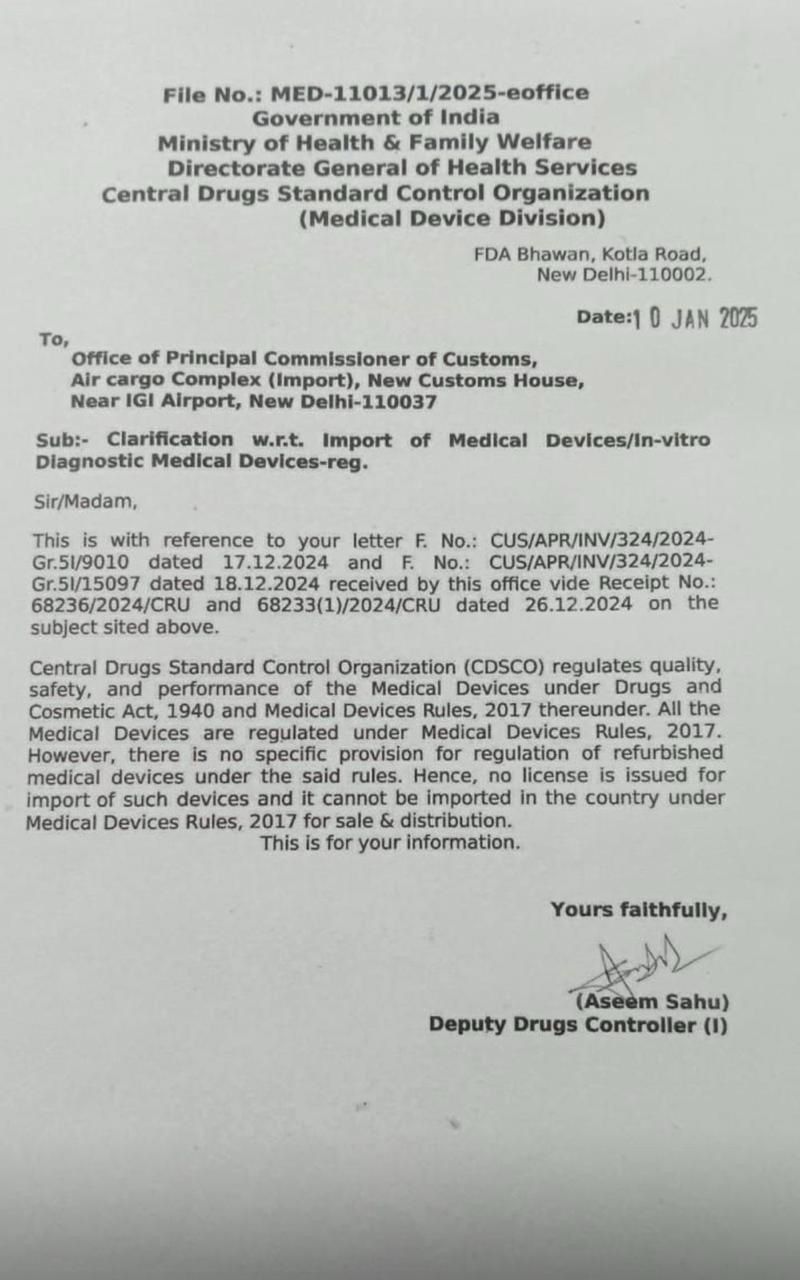
Import of refurbished medical devices are not allowed – CDSCO
Central Drugs Standard Control Organisation (CDSCO) regulates Quality, Safety and Performance of the Medical Devices under Drugs and Cosmetics Act, 1940 and Medical Devices Rules 2017.
To control the second-hand / unregulated medical devices in the country, recently CDSCO has issued a letter to the Principal Commissioner of Customs, New Delhi, clarifying that No separate license is issued for import of refurbished medical devices in the country. Following points are covered in the communication
All the Medical Devices are regulated under Medical Devices Rules 2017
However, there is no specific provision for regulation of refurbished medical devices under the said Medical Devices Rules 2017
Hence no license is issued for import of such devices and it cannot be imported in the country under Medical Devices Rules 2017 for sale and distribution.
Digital Personal Data Protection Rules, 2025- DRAFT
The Ministry of Electronics and Information Technology (MeitY) has released the draft ‘Digital Personal Data Protection Rules,2025’.
The draft rules along with a explanatory note of the rules in plain and simple language to facilitate ease of understanding are available on Ministry’s website at www.meity.gov.in/data-protection-framework.
Standard IVD Evaluation Protocols – Drafted by ICMR and CDSCO
Indian Council of Medical Research (ICMR) and the Central Drugs Standard Control Organization (CDSCO) have jointly issued the Draft Standard IVD Evaluation Protocols
The document outlines the need for standardized evaluation protocols for IVDs as mandated by the Medical Devices Rules 2017. These protocols are essential to ensure the quality and performance of diagnostic kits used in India
Several specific performance evaluation protocols have been drafted, including those for:
a. Chikungunya IgM ELISA b. Dengue NS1 RDT and ELISA c. Zika virus real-time PCR , among others
The document includes detailed guidelines for evaluating various IVDs, emphasizing:
i. Study design and ethical considerations ii.Requirements for evaluation sites and laboratory standards iii.Procedures for conducting diagnostic accuracy studies iv.Acceptance criteria for sensitivity and specificity of tests.
This initiative by ICMR and CDSCO aims to enhance the reliability of diagnostic testing in India through structured evaluation processes, ensuring that manufacturers adhere to high standards of quality in their products. Stakeholder engagement is critical to refining these protocols before their final adoption.
Stakeholders are invited to provide comments on these protocols until February 15, 2025.
Comments should be submitted via email before 15th February 2025, at ivdevaluation@gmail.com as per the specified format given in the notification


 Bonus: The first 100 Fellows to complete the course get a free 3-month subscription to GSC’s Carbon Emissions Learning Lab.
 To know more, please visit : fellowship@isqua.org | www.isqua.org/education